For this question, refer to the Dress4Win case study. Which of the compute services should be migrated as-is and would still be an optimized architecture for performance in the cloud?
Answer
Web applications deployed using App Engine standard environment
RabbitMQ deployed using an unmanaged instance group
Hadoop/Spark deployed using Cloud Dataproc Regional in High Availability mode
Card 22
Question
For this question, refer to the TerramEarth case study. To be compliant with European GDPR regulation, TerramEarth is required to delete data generated from its European customers after a period of 36 months when it contains personal data. In the new architecture, this data will be stored in both Cloud Storage and BigQuery. What should you do?
Answer
Create a BigQuery table for the European data, and set the table retention period to 36 months. For Cloud Storage, use gsutil to enable lifecycle management using a DELETE action with an Age condition of 36 months.
Create a BigQuery table for the European data, and set the table retention period to 36 months. For Cloud Storage, use gsutil to create a SetStorageClass to NONE action when with an Age condition of 36 months.
Create a BigQuery time-partitioned table for the European data, and set the partition period to 36 months. For Cloud Storage, use gsutil to create a SetStorageClass to NONE action with an Age condition of 36 months.
Create a BigQuery time-partitioned table for the European data, and set the partition expiration period to 36 months. For Cloud Storage, use gsutil to enable lifecycle management using a DELETE action with an Age condition of 36 months.
Card 23
Question
You want to enable your running Google Kubernetes Engine cluster to scale as demand for your application changes.
What should you do?
Answer
Add additional nodes to your Kubernetes Engine cluster using the following command: gcloud container clusters resize CLUSTER_Name – -size 10
Add a tag to the instances in the cluster with the following command: gcloud compute instances add-tags INSTANCE - -tags enableautoscaling max-nodes-10
Update the existing Kubernetes Engine cluster with the following command: gcloud alpha container clusters update mycluster - -enableautoscaling - -min-nodes=1 - -max-nodes=10
Create a new Kubernetes Engine cluster with the following command: gcloud alpha container clusters create mycluster - -enableautoscaling - -min-nodes=1 - -max-nodes=10 and redeploy your application
Card 24
Question
Your marketing department wants to send out a promotional email campaign. The development team wants to minimize direct operation management. They project a wide range of possible customer responses, from 100 to 500,000 click-through per day. The link leads to a simple website that explains the promotion and collects user information and preferences.
Which infrastructure should you recommend? Choose 2 answers.
Answer
Use Google App Engine to serve the website and Google Cloud Datastore to store user data.
Use a Google Container Engine cluster to serve the website and store data to persistent disk.
Use a managed instance group to serve the website and Google Cloud Bigtable to store user data.
Use a single Compute Engine virtual machine (VM) to host a web server, backend by Google Cloud SQL.
Card 25
Question
Your company just finished a rapid lift and shift to Google Compute Engine for your compute needs. You have another 9 months to design and deploy a more cloudnative solution. Specifically, you want a system that is no-ops and auto-scaling.
Which two compute products should you choose? Choose 2 answers.
Answer
Compute Engine with containers
Google Kubernetes Engine with containers
Google App Engine Standard Environment
Compute Engine with managed instance groups
Compute Engine with custom instance types
Card 26
Question
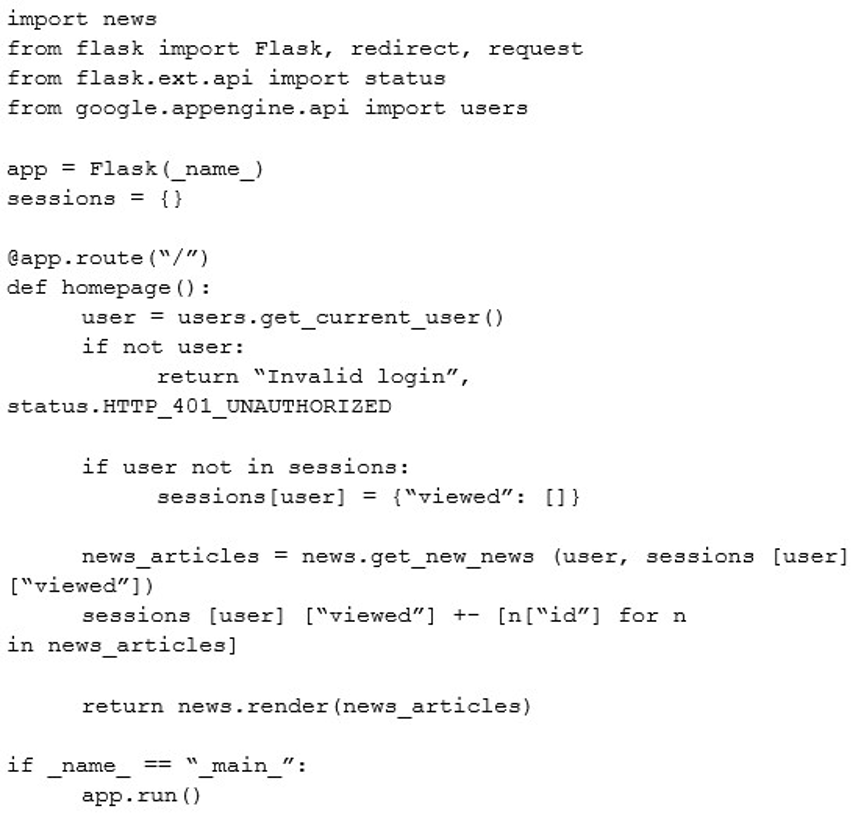
A news feed web service has the following code running on Google App Engine. During peak load, users report that they can see news articles they already viewed.
What is the most likely cause of this problem?
Answer
The session variable is local to just a single instance
The session variable is being overwritten in Cloud Datastore
The URL of the API needs to be modified to prevent caching
The HTTP Expires header needs to be set to -1 stop caching
Card 27
Question
An application development team believes their current logging tool will not meet their needs for their new cloud-based product. They want a better tool to capture errors and help them analyze their historical log data. You want to help them find a solution that meets their needs.
What should you do?
Answer
Direct them to download and install the Google StackDriver logging agent
Send them a list of online resources about logging best practices
Help them define their requirements and assess viable logging tools
Help them upgrade their current tool to take advantage of any new features
Card 28
Question
You need to reduce the number of unplanned rollbacks of erroneous production deployments in your company’s web hosting platform. Improvement to the QA/Test processes accomplished an 80% reduction.
Which additional two approaches can you take to further reduce the rollbacks? Choose 2 answers.
Answer
Introduce a green-blue deployment model
Replace the QA environment with canary releases
Fragment the monolithic platform into microservices
Reduce the platform’s dependency on relational database systems
Replace the platform’s relational database systems with a NoSQL database
Card 29
Question
To reduce costs, the Director of Engineering has required all developers to move their development infrastructure resources from on-premises virtual machines (VMs) to Google Cloud Platform. These resources go through multiple start/stop events during the day and require state to persist. You have been asked to design the process of running a development environment in Google Cloud while providing cost visibility to the finance department.
Which two steps should you take? Choose 2 answers.
Answer
Use the - -no-auto-delete flag on all persistent disks and stop the VM
Use the - -auto-delete flag on all persistent disks and terminate the VM
Apply VM CPU utilization label and include it in the BigQuery billing export
Use Google BigQuery billing export and labels to associate cost to groups
Store all state into local SSD, snapshot the persistent disks, and terminate the VM
Store all state in Google Cloud Storage, snapshot the persistent disks, and terminate the VM
Card 30
Question
Your company wants to track whether someone is present in a meeting room reserved for a scheduled meeting. There are 1000 meeting rooms across 5 offices on 3 continents. Each room is equipped with a motion sensor that reports its status every second. The data from the motion detector includes only a sensor ID and several different discrete items of information. Analysts will use this data, together with information about account owners and office locations.
Which database type should you use?
Answer
Flat file
NoSQL
Relational
Blobstore
Card 31
Question
You set up an autoscaling instance group to serve web traffic for an upcoming launch. After configuring the instance group as a backend service to an HTTP(S) load balancer, you notice that virtual machine (VM) instances are being terminated and re-launched every minute. The instances do not have a public IP address.
You have verified the appropriate web response is coming from each instance using the curl command. You want to ensure the backend is configured correctly.
What should you do?
Answer
Ensure that a firewall rules exists to allow source traffic on HTTP/HTTPS to reach the load balancer.
Assign a public IP to each instance and configure a firewall rule to allow the load balancer to reach the instance public IP.
Create a tag on each instance with the name of the load balancer. Configure a firewall rule with the name of the load balancer as the source and the instance tag as the destination.
Ensure that a firewall rule exists to allow load balancer health checks to reach the instances in the instance group.
Card 32
Question
You write a Python script to connect to Google BigQuery from a Google Compute Engine virtual machine. The script is printing errors that it cannot connect to BigQuery.
What should you do to fix the script?
Answer
Install the latest BigQuery API client library for Python
Create a new service account with BigQuery access and execute your script with that user
Run your script on a new virtual machine with the BigQuery access scope enabled
Install the bq component for gcloud with the command gcloud components install bq.
Card 33
Question
You have been asked to select the storage system for the click-data of your company’s large portfolio of websites. This data is streamed in from a custom website analytics package at a typical rate of 6,000 clicks per minute. With bursts of up to 8,500 clicks per second. It must have been stored for future analysis by your data science and user experience teams.
Which storage infrastructure should you choose?
Answer
Google Cloud SQL
Google Cloud Bigtable
Google Cloud Storage
Google Cloud Datastore
Card 34
Question
Your company is forecasting a sharp increase in the number and size of Apache Spark and Hadoop jobs being run on your local datacenter. You want to utilize the cloud to help you scale this upcoming demand with the least amount of operations work and code change.
Which product should you use?
Answer
Google Cloud Dataflow
Google Compute Engine
Google Cloud Dataproc
Google Kubernetes Engine
Card 35
Question
You want to optimize the performance of an accurate, real-time, weather-charting application. The data comes from 50,000 sensors sending 10 readings a second, in the format of a timestamp and sensor reading.
Where should you store the data?
Answer
Google BigQuery
Google Cloud SQL
Google Cloud Bigtable
Google Cloud Storage
Card 36
Question
Your company’s user-feedback portal comprises a standard LAMP stack replicated across two zones. It is deployed in the us-central1 region and uses autoscaled managed instance groups on all layers, except the database. Currently, only a small group of select customers have access to the portal. The portal meets a 99,99% availability SLA under these conditions. However next quarter, your company will be making the portal available to all users, including unauthenticated users. You need to develop a resiliency testing strategy to ensure the system maintains the SLA once they introduce additional user load.
What should you do?
Answer
Capture existing users input, and replay captured user load until autoscale is triggered on all layers. At the same time, terminate all resources in one of the zones
Create synthetic random user input, replay synthetic load until autoscale logic is triggered on at least one layer, and introduce “chaos” to the system by terminating random resources on both zones
Expose the new system to a larger group of users, and increase group size each day until autoscale logic is triggered on all layers. At the same time, terminate random resources on both zones
Capture existing users input, and replay captured user load until resource utilization crosses 80%. Also, derive estimated number of users based on existing user’s usage of the app, and deploy enough resources to handle 200% of expected load
Card 37
Question
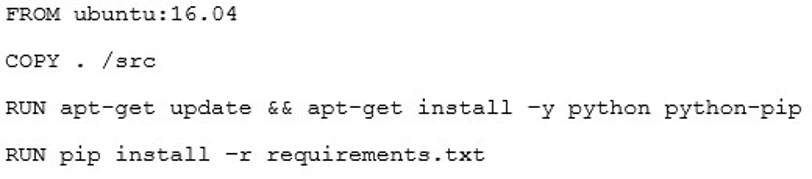
One of the developers on your team deployed their application in Google Container Engine with the Dockerfile below. They report that their application deployments are taking too long.
You want to optimize this Dockerfile for faster deployment times without adversely affecting the app’s functionality.
Which two actions should you take? Choose 2 answers.
Answer
Remove Python after running pip
Remove dependencies from requirements.txt
Use a slimmed-down base image like Alpine Linux
Use larger machine types for your Google Container Engine node pools
Copy the source after he package dependencies (Python and pip) are installed
Card 38
Question
Your solution is producing performance bugs in production that you did not see in staging and test environments. You want to adjust your test and deployment procedures to avoid this problem in the future.
What should you do?
Answer
Deploy fewer changes to production
Deploy smaller changes to production
Deploy changes to a small subset of users before rolling out to production
Increase the load on your test and staging environments
Card 39
Question
You are designing a large distributed application with 30 microservices. Each of your distributed microservices needs to connect to a database back-end. You want to store the credentials securely.
Where should you store the credentials?
Answer
In the source code
In an environment variable
In a secret management system
In a config file that has restricted access through ACLs
Card 40
Question
A lead engineer wrote a custom tool that deploys virtual machines in the legacy data center. He wants to migrate the custom tool to the new cloud environment. You want to advocate for the adoption of Google Cloud Deployment Manager.
What are two business risks of migrating to Cloud Deployment Manager? Choose 2 answers.
Answer
Cloud Deployment Manager uses Python
Cloud Deployment Manager is unfamiliar to the company’s engineers
Cloud Deployment Manager APIs could be deprecated in the future
Cloud Deployment Manager requires a Google APIs service account to run
Cloud Deployment Manager can be used to permanently delete cloud resources
Cloud Deployment Manager only supports automation of Google Cloud resources
How to use this set
Read the preview and check whether the content and answers suit your learning goal. You can add the public set to your sets to study it. Your account shows the available actions.