Create AI flashcards for your lessons
A chapter does not automatically make a good flashcard set. Follow this workflow to create an AI draft from existing teaching materials, check the questions and help your class practise. The water cycle is our example; the steps also work for other subjects.
1. Choose a learning objective you can check
Decide what learners should be able to explain. For the water cycle, they might distinguish evaporation, condensation and precipitation and explain how they connect. Keep the first set focused on that objective rather than an entire textbook. You can then check whether each card belongs in the lesson.
2. Prepare suitable source material
Select a short, accurate extract from your teaching materials. Only use material you have permission to use for this purpose. Remove names, grades and other personal details. Before uploading, also check whether the content is suitable for processing by external AI services; consult the privacy policy.
Privacy3. Create an initial draft with AI
Use MemoCard’s document-to-flashcard AI feature to generate a first suggestion. Then edit the resulting set in the editor. Each card should ask a clear question with a verifiable answer. Split suggestions that cover several topics into individual cards. The documentation explains how to use the editor.
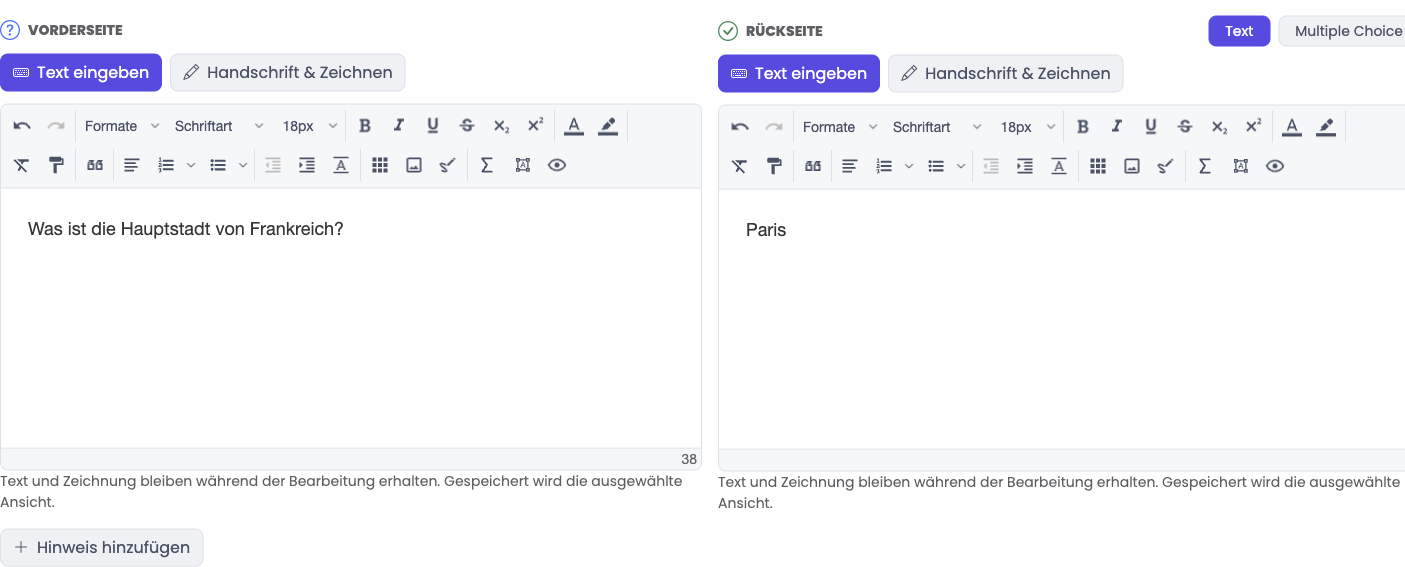
4. Check questions and answers for accuracy
Compare every answer with your source material. Are the terms and explanations correct? Does the question make sense without the original paragraph? Remove duplicates and fill important gaps. For multiple-choice questions, both correct and incorrect options must be unambiguous. AI suggestions are drafts; you approve the content.
5. Practise with your class and discuss the results
Assign the checked set to the relevant learning group. Learners can practise with card stacks, the Leitner system or exam mode. Use the learning overview to prompt discussion: which terms are confused and which connections are missing? Recorded learning activity does not replace a teacher’s assessment.
Explore organisation managementExample: Three flashcards about the water cycle
These sample cards illustrate different questions. Adapt the language and detail to your learners’ level and teaching materials.
What is evaporation?
Liquid water changes into water vapour at its surface.
How do cloud droplets form?
Water vapour condenses into tiny water droplets when the air cools sufficiently and the necessary conditions are met.
How do evaporation and precipitation differ?
Evaporation moves water into the air as water vapour. Precipitation brings water from clouds to the Earth’s surface, for example as rain or snow.
A possible lesson sequence
Prepare and check the set before class. After introducing the topic, let learners practise the terms. In a later lesson, work through the whole cycle and discuss remaining questions together. Improve unclear cards before using them with another class. This is a teaching suggestion, not an automatic MemoCard feature.